Compliance "Stoplight" 12 | Utility Allowances Change at Lease Renewal
Sep 23, 2026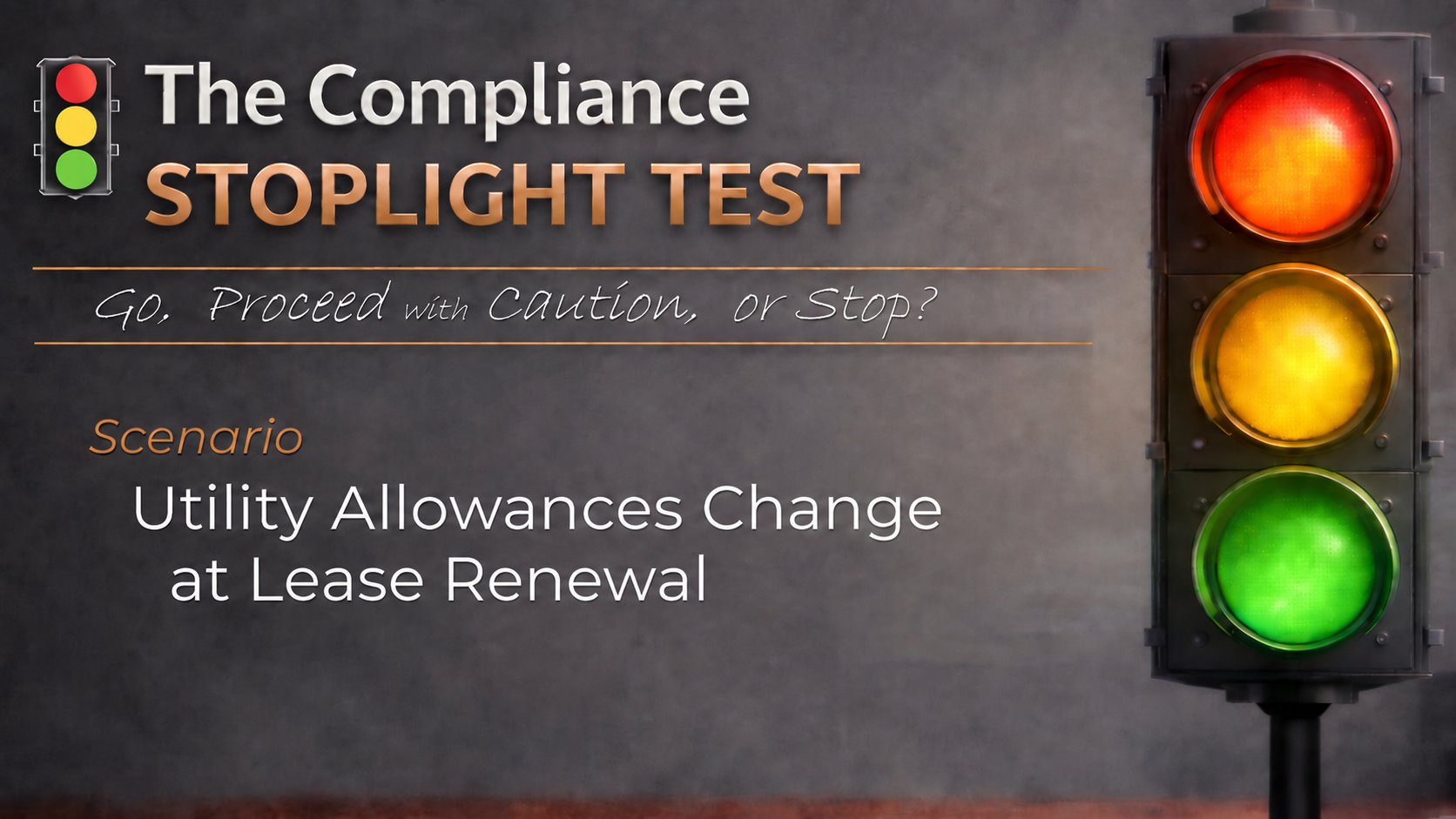
In LIHTC compliance, the difference between a harmless practice and a serious violation can come down to a single regulatory detail. Each Compliance Stoplight Test presents a real-world scenario. What color is the compliance stoplight for this situation: Green Light (tax credits are safe), Yellow Light (proceed with caution), or Red Light (tax credit loss is imminent)?
Scenario
The maximum gross rent for an LIHTC unit is $1,250. The tenant pays $1,100 in rent and pays utilities directly. The applicable utility allowance is $150, so the unit is being charged the maximum gross rent.
The applicable utility allowance is now $200, up from $150. Management decides to leave the tenant rent at $1,100 until the resident's next lease renewal four months later. At renewal, management plans to reduce the tenant rent to account for the higher utility allowance.
What color is the compliance stoplight?
🟢 Green Light – Tax credits are safe
🟡 Yellow Light – Proceed with caution
🔴 Red Light – Tax credit loss is imminent
Food for thought: Lease renewal is a common time to change tenant rent. But does the lease renewal date control when an LIHTC utility allowance must be implemented?
Stoplight Reveal
🔴 Red Light – Tax credit loss is imminent
Once the new utility allowance is effective, management cannot wait until lease renewal to make any necessary rent adjustment.
More Details
Because the tenant pays utilities directly, the applicable utility allowance is included in gross rent. The original $1,100 rent plus the $150 allowance equals the $1,250 maximum gross rent.
Treas. Reg. §1.42-10(c)(1) provides that when an applicable utility allowance changes, the new allowance must be used to compute gross rents due after the applicable 90-day period. The precise starting point for that period depends on the utility-allowance method.
Once the $200 allowance is effective, continuing to charge $1,100 produces a $1,300 gross rent: $1,100 tenant rent plus the $200 utility allowance. That is $50 above the $1,250 maximum. Waiting until lease renewal four months later to reduce the tenant rent results in excess rent.
IRS Publication 5913 identifies failure to update rents after the applicable 90-day period as an error that may result in noncompliance.
Compliance Insight
Do not use the lease renewal date as the compliance calendar for utility-allowance changes. Once a new allowance is effective, make any required rent adjustment immediately.
References
- IRC §42(g)(2)(B)(ii)
- Treas. Reg. §1.42-10(c)(1)
- IRS Publication 5913 (Rev. Jan. 2024), Chapter XVIII, Category 11m, A.9 – Updating Utility Allowances; C – Out of Compliance
Did the result surprise you? Watch for next week’s Compliance Stoplight Test.
There is a very good chance that the topic of this post is covered in an online on-demand course at Costello University.
Stay connected with news and updates!
Join our mailing list to receive the latest news and updates from our team.
Don't worry, your information will not be shared.
We hate SPAM. We will never sell your information, for any reason.