Compliance "Stoplight" 5 | Family Reports Zero Income
Apr 23, 2026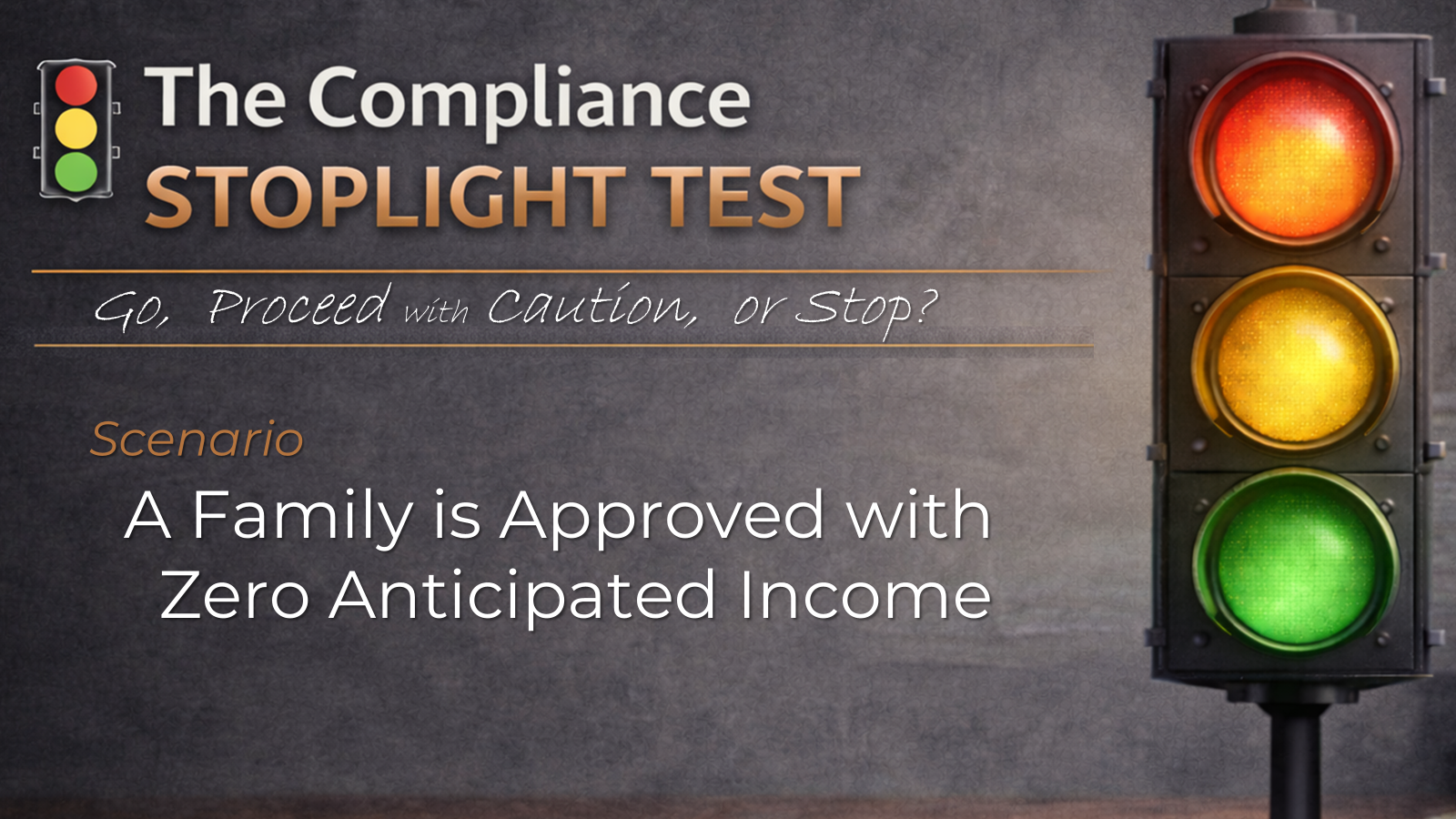
In LIHTC compliance, the difference between a harmless practice and a serious violation can come down to a single regulatory detail. Each Compliance Stoplight Test presents a real-world scenario. What color is the compliance stoplight for this situation: Green Light (tax credits are safe), Yellow Light (proceed with caution), or Red Light (tax credit loss is imminent)?
Scenario
A family reports having no income. Food and clothing are provided by a local food bank, and medical expenses are covered by Medicaid. The family reports receiving no other monetary or in-kind contributions.
What color is the compliance stoplight?
🟢 Green Light – Tax credits are safe
🟡 Yellow Light – Proceed with caution
🔴 Red Light – Tax credit loss is imminent
Food for thought: Most major types of expenses seem to be covered. Is something major missing?
Stoplight Reveal
🟡 Yellow Light – Proceed with caution
No-income certification requires careful review as to how a family will meet major needs, including rent. Whether this situation ultimately represents a compliance issue may depend on how the family is paying rent and whether the unit is receiving rental assistance.
More Details
If the family is required to pay a set rent, it is unreasonable for an owner to sign a certification showing zero income on one hand and a lease requiring rent on the other without understanding how the rent is being paid. Receipt of project-based or tenant-based rental assistance, however, may address this concern.
LIHTC income determinations rely on the Section 8 definition of annual income, which excludes many forms of income that may be used to pay normal family expenses, including rent. Noncash in-kind support, such as food, clothing, or toiletries, from a food bank and other benefits, such as Medicaid, are not counted as income. The same is true of other forms of assistance, such as WIC, SNAP benefits, and many other types of support a family may receive. As a result, a family may sometimes legitimately report zero income and reasonably meet normal expenses. Importantly, though, a no-income certification requires management to understand how the family is also meeting its housing costs. If the family receives rental assistance, the absence of income may be easier to explain because the subsidy may cover most or all rent. If there is no rental assistance, management should confirm that the family is not receiving unreported financial support or regular cash contributions that should be included in income to pay the rent.
The key issue is not whether zero income is possible. The issue is whether the file adequately documents the family’s reported circumstances and how expenses are reasonably met. In this scenario, we have a yellow light. We do not know how rent is being paid, and we proceed with caution.
Compliance Insight
A zero-income certification is not inherently noncompliant, but the file should reasonably explain how the family is meeting major expenses, especially rent. If another source is paying rent, determine whether that source is countable income.
References
- Treas. Reg. §1.42-5(b)(1)(vii)
- 24 CFR §5.603 and §5.609(b)
- 8823 Guide (2024) IV, G
Did the result surprise you? Watch for next week’s Compliance Stoplight Test.
There is a very good chance that the topic of this post is covered in an online on-demand course at Costello University.
Stay connected with news and updates!
Join our mailing list to receive the latest news and updates from our team.
Don't worry, your information will not be shared.
We hate SPAM. We will never sell your information, for any reason.