Compliance "Stoplight" 2 | State-Required Recertifications Missing
Apr 02, 2026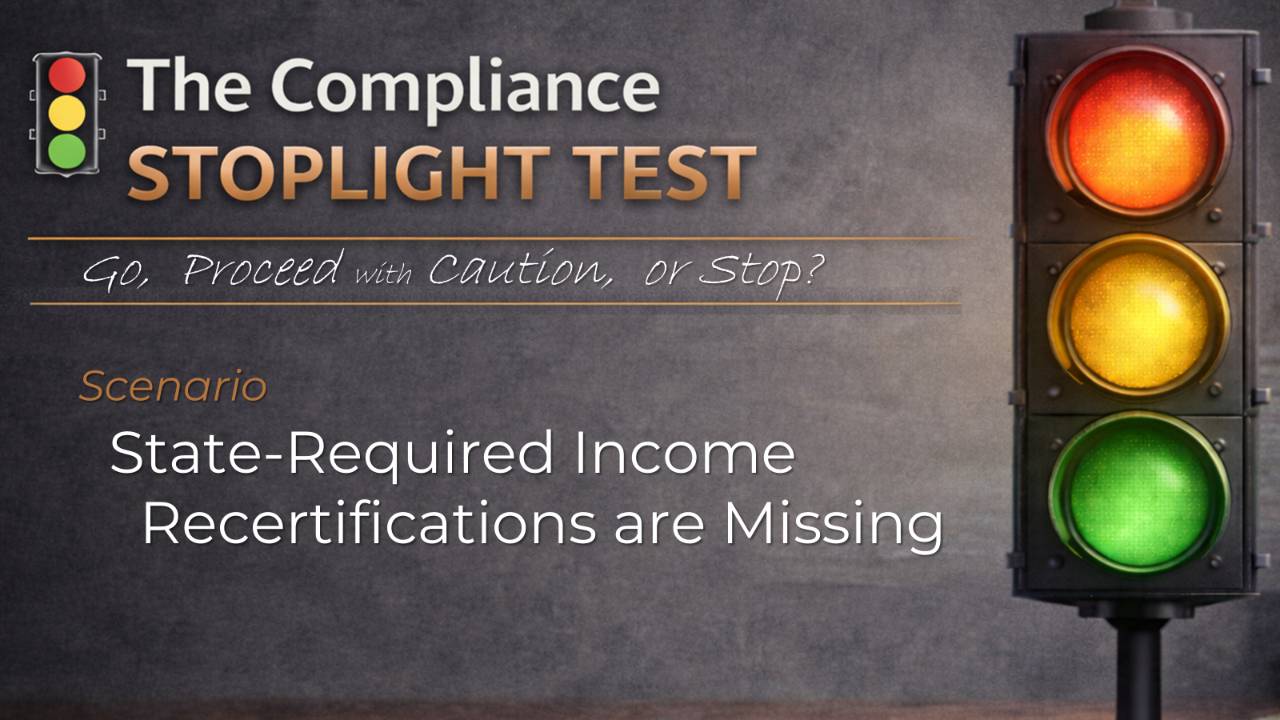
In LIHTC compliance, the difference between a harmless practice and a serious violation can come down to a single regulatory detail. Each Compliance Stoplight Test presents a real-world scenario. What color is the compliance stoplight for this situation: Green Light (tax credits are safe), Yellow Light (proceed with caution), or Red Light (tax credit loss is imminent)?
Scenario
A property where all units are LIHTC stopped performing annual income recertifications for existing families after learning that federal law no longer requires them at 100% LIHTC properties. However, the state allocating agency’s compliance manual still requires annual recertifications.
What color is the compliance stoplight?
🟢 Green Light – Tax credits are safe
🟡 Yellow Light – Proceed with caution
🔴 Red Light – Tax credit loss is imminent
Food for thought: In a survey, many compliance professionals immediately assumed this situation was a Red Light or a Green Light, but the majority (66%) thought that there was some level of risk to the federal credits for a Yellow Light.
Stoplight Reveal
🟢 Green Light – Tax credits are safe
Although this situation may violate a state compliance policy, it does not threaten the LIHTC status of the units under Section 42.
More Details
Before 2008, all LIHTC properties were required to complete annual income recertifications for existing families. However, in 2008, with the Housing and Economic Recovery Act (HERA), Congress eliminated that requirement for 100% low-income LIHTC projects. As a result, Section 42 no longer requires annual recertifications once a family has been properly income-qualified at move-in. Because federal law does not require the recertifications, failing to perform them does not create a reportable noncompliance event under Section 42. State allocating agencies may still require annual recertifications as part of their compliance monitoring programs through policies in Qualified Allocation Plans (QAPs), compliance manuals, or other publications. Owners and agents are generally expected to follow those policies. However, violating a state administrative policy does not create a federal LIHTC violation.
As long as the family was properly income-qualified at move-in and all other Section 42 requirements are met, the unit remains a qualified LIHTC unit, and this is a green light situation. According to the 8823 Guide, noncompliance with income recertification requirements at 100% LIHTC properties is not reported to the IRS as a Section 42 violation.
Compliance Insight
A practice may violate a state compliance policy without creating a violation of Section 42. Understanding that distinction helps owners and agents focus their attention first on issues that put tax credits at risk. Of course, the next high priority is meeting state agency policies.
References
- IRC §42(g)(8)(B)
- IRC §142(d)(3)(A)
- 8823 Guide (2024) V, A.4
- 8823 Guide (2024) XXIII, B.2
Did the result surprise you? Watch for next week’s Compliance Stoplight Test.
There is a very good chance that the topic of this post is covered in an online on-demand course at Costello University.
Stay connected with news and updates!
Join our mailing list to receive the latest news and updates from our team.
Don't worry, your information will not be shared.
We hate SPAM. We will never sell your information, for any reason.