Compliance "Stoplight" 4 | Income Goes Way Over-Income Soon After Move-in
Apr 16, 2026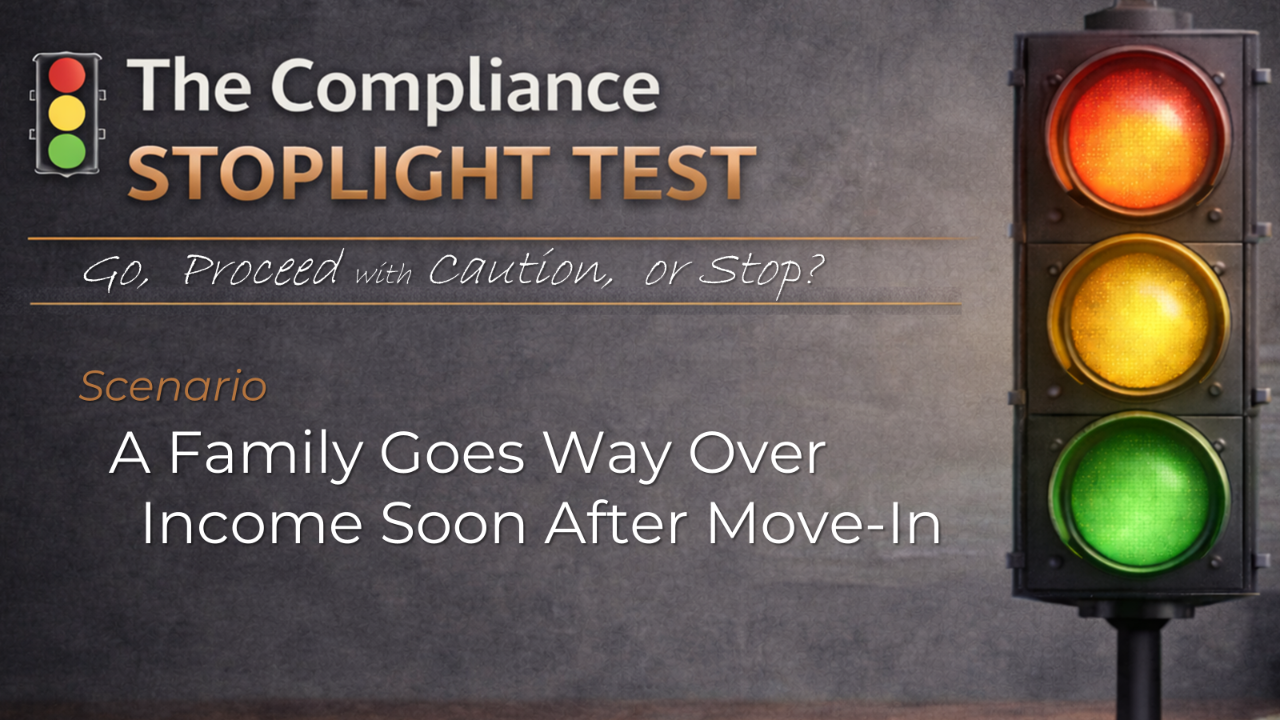
In LIHTC compliance, the difference between a harmless practice and a serious violation can come down to a single regulatory detail. Each Compliance Stoplight Test presents a real-world scenario. What color is the compliance stoplight for this situation: Green Light (tax credits are safe), Yellow Light (proceed with caution), or Red Light (tax credit loss is imminent)?
Scenario
A family moves into an LIHTC unit and is properly income-qualified at move-in. Four months later, one adult family member applies for and receives a promotion, and the family’s income increases significantly, considerably over the income limits. Management learns about the change and worries that the family may no longer qualify for the unit.
What color is the compliance stoplight?
🟢 Green Light – Tax credits are safe
🟡 Yellow Light – Proceed with caution
🔴 Red Light – Tax credit loss is imminent
Food for thought: Is this a Yellow Light, depending on how much the family now makes? Voters in a LinkedIn poll tended to believe this was a green light situation, but several felt it was yellow or red.
Stoplight Reveal
🟢 Green Light – Tax credits are safe
An increase in a family’s income after move-in does not cause the unit to lose its qualified LIHTC status.
More Details
If the family was properly income-qualified when they moved into the unit, the unit remains qualified even if the family’s income later increases, even dramatically. The 8823 Guide indicates that this can even occur following move-in by just few months, in an example where a spouse who is unemployed at move-in gets a new job. After initial qualification, the LIHTC program does not require families to remain income-qualified throughout their tenancy. This principle is sometimes described as “once qualified, always qualified.”
However, significant income increases can trigger the Available Unit Rule (AUR). When a family’s income rises above 140% of the applicable income limit, the unit continues to qualify as a low-income unit if the owner rents the next available comparable or smaller unit in the building to a qualified low-income family. Importantly, the AUR does not affect the qualified status of the original unit or the family’s right to remain in the unit. Instead, it governs how the property must rent future available units in the building.
In this scenario, the promotion and resulting income increase do not threaten the tax credits associated with the family’s unit. It is a green light situation.
Compliance Insight
Unanticipated income increases after move-in do not disqualify a family from an LIHTC unit. The key compliance question is whether the family was properly income-qualified at move-in.
References
- IRC §42(g)(2)(D)
- 8823 Guide (2024) IV, M.7
- 8823 Guide (2024) XIV, A
Did the result surprise you? Watch for next week’s Compliance Stoplight Test.
There is a very good chance that the topic of this post is covered in an online on-demand course at Costello University.
Stay connected with news and updates!
Join our mailing list to receive the latest news and updates from our team.
Don't worry, your information will not be shared.
We hate SPAM. We will never sell your information, for any reason.