Compliance "Stoplight" 10 | Account Not Verified with Bank
Jun 24, 2026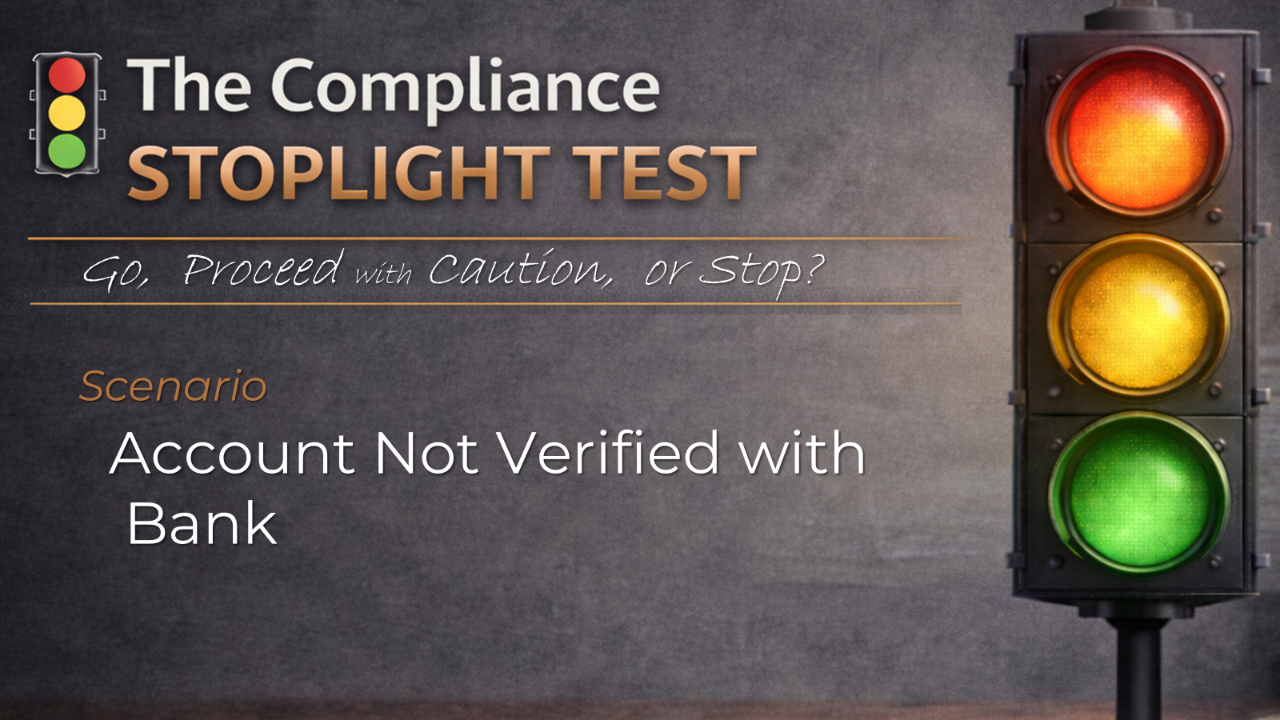
In LIHTC compliance, the difference between a harmless practice and a serious violation can come down to a single regulatory detail. Each Compliance Stoplight Test presents a real-world scenario. What color is the compliance stoplight for this situation: Green Light (tax credits are safe), Yellow Light (proceed with caution), or Red Light (tax credit loss is imminent)?
Scenario
During a 2026 income certification, a family reports having a bank account with a balance of $55,890. Instead of verifying the account directly with the financial institution on a form, management relies on unsigned, electronically downloaded bank statements provided by the family rather than a verification form completed by the financial institution.
What color is the compliance stoplight?
🟢 Green Light – Tax credits are safe
🟡 Yellow Light – Proceed with caution
🔴 Red Light – Tax credit loss is imminent
Food for thought: Bank statements came from the family rather than directly from the bank. Does LIHTC require third-party verification directly from the financial institution?
Stoplight Reveal
🟢 Green Light – Tax credits are safe
The LIHTC program requires owners and agents to verify assets, but it does not require verification directly from the financial institution. Bank statements provided by the family may satisfy the verification requirement when they clearly establish the value of the asset and any income it produces.
More Details
Section 42 requires owners and agents to determine whether a family is income-qualified using verified income and assets, but neither the statute nor the regulations prescribe a single verification method. While industry practice once favored third-party verification directly from financial institutions, HUD guidance has increasingly recognized that reliable documentation supplied by the family can be an acceptable form of verification.
The HOTMA verification framework reinforces this principle by establishing a verification hierarchy that allows the use of credible documentation, including documents provided by the family, when determining income and assets. This approach is consistent with LIHTC regulations, which require owners to maintain sufficient documentation supporting tenant income certifications but do not prescribe a particular verification format. The regulations specifically contemplate supporting documentation such as tax returns, W-2 forms, and similar records as acceptable evidence supporting income determinations.
Compliance Insight
The LIHTC program requires reliable documentation—not a particular verification form. When account statements clearly establish the value of an asset and any income it generates, they can satisfy the program's verification requirements.
References
- 26 CFR § 1.42-5(b)(1)(vii)
- 8823 Guide (2024), V.A
- HUD Notice H-2023-10, Attachment J — Verification Hierarchy
Did the result surprise you? Watch for next week’s Compliance Stoplight Test.
There is a very good chance that the topic of this post is covered in an online on-demand course at Costello University.
Stay connected with news and updates!
Join our mailing list to receive the latest news and updates from our team.
Don't worry, your information will not be shared.
We hate SPAM. We will never sell your information, for any reason.