What's the Deal with 30-Day Eviction Requirements?
Mar 05, 2026
Recent changes to Rural Development and HUD housing guidance relating to 30-day notices of eviction have been a hot topic of conversation among housing providers. Here we will discuss the changes, what they mean, and the significant caution owners and agents should consider as they consult expert guidance on the matter.
Step One | The CARES Act
The Coronavirus Aid, Relief, and Economic Security (CARES) Act (Section 4024 (codified at 15 U.S.C. § 9058), signed into law in March 2020, was designed to provide relief to Americans heavily impacted by the COVID-19 pandemic. The CARES Act requires owners and agents of covered dwelling units to provide tenants with at least 30 days’ notice to vacate before the tenant can be required to leave the unit. Although the CARES Act originally included a temporary eviction moratorium that expired, the separate requirement that covered tenants receive at least 30 days’ notice to vacate was not time-limited and remains part of federal law.
What are "covered dwellings" under this provision of CARES? Under the CARES Act, a covered dwelling is a rental unit located in a property either financed with a federally backed mortgage or multifamily mortgage loan (such as FHA, VA, USDA, Fannie Mae, or Freddie Mac) or participating in a housing program included in the Violence Against Women Act (VAWA) definition of a “covered housing program.” These programs include public housing, Section 8 Housing Choice Voucher and project-based Section 8 assistance, Section 202 housing for the elderly, Section 811 housing for persons with disabilities, the HOME program, the Housing Opportunities for Persons with AIDS (HOPWA) program, McKinney-Vento homeless assistance programs, USDA rural housing programs, and the Low-Income Housing Tax Credit (LIHTC) program.
Has CARES been repealed? Congress has not repealed section 4024 of the CARES Act, the part that spells out the 30-day eviction requirement. There has been some movement in this regard, but it is still legally applicable to covered dwellings.
Step Two | HUD & RD Respond in Regulation/Guidance
Although the LIHTC is covered under the CARES Act, the IRS never issued any guidance on compliance with the 30-day requirement for the tax credit program. As with many aspects of the LIHTC program, some state housing agencies issued their own guidance on the issue that an owner/agent must be aware of. The HOME Funds program has always had a statutory 30-day notice requirement for all evictions of HOME tenant, so this has not been an issue for HOME. The NHTF is also a covered program without a 30-day requirement separate from CARES, and HUD did not address this for NHTF purposes.
Both HUD and Rural Development developed regulations or other guidance to support the CARES Act eviction provision. Shortly after the CARES Act was enacted, both HUD and Rural Development issued guidance explaining that covered properties were subject to the Act’s eviction protections, including the requirement that tenants receive at least 30 days’ notice to vacate before eviction. HUD and USDA Rural Development later incorporated the CARES Act eviction notice requirement into program regulations through formal rulemaking. See 30-Day Notification Requirement Prior to Termination of Lease for Nonpayment of Rent, 89 Fed. Reg. 101,270 (Dec. 13, 2024) (amending 24 CFR pts. 247, 880, 882, 884, 886, 891, and 966) HERE; 30-Day Notification of Nonpayment of Rent in Multi-Family Housing Direct Loan Programs, 89 Fed. Reg. 20,539 (Mar. 25, 2024) HERE (amending 7 CFR 3560.159(a)(3)).
Step Three | HUD & RD Remove Eviction Guidance
On February 25, 2026, Rural Development issued a final rule HERE amending 7 CFR §3560.159(a)(3) and §3560.156(c)(18)(xvi) removing the regulatory requirement that RD Sections 515 and 514 multifamily housing properties provide at least 30 days notice before initiating eviction for nonpayment of rent.
According to RD, regulation enforcing CARES compliance "proved unnecessary because compliance with the Coronavirus Aid, Relief, and Economic Security Act (CARES Act) 30 day notice is generally captured by MFH project management requirements." Further the Notice said "RHS is also confident the longstanding guidelines and regulations in Section 515 and Section 514 MFH tenant recertification process, which predate the 30-Day Notice Final Rule and the CARES Act, protect its tenants from being evicted less than 30 days from receiving notice of non-payment. These programs have effective tools to prevent eviction based solely on the nonpayment of rent. Tenants with changes in employment or other financial situations may file an interim income certification with the borrower for an income change of $50 or more. This allows the borrower to receive additional rental subsidy on behalf of the tenant, when funding is available. While waiting for funding, RHS finds that borrowers generally work with tenants on developing a repayment plan when there is not an additional lease violation." Owners/agents of RD properties know that eviction in a quicker timeframe was common before CARES, and much commentary on this issue from trade organizations center on just this ability returning to owners. Despite the perceived removal of the 30-day requirement, RD finally also clarified "CARES Act 30-day notice requirement for nonpayment of rent is still in effect for [RD] MFH properties regardless of whether the CARES Act wording is specifically included in the MFH's regulation."
RD Summary | RD removed regulations to conform to the CARES Act, but makes it clear that the 30-day requirements relating to eviction and nonpayment of rent still exist in federal statute.
One day after RD issued its Rule, February 26, 2026, HUD issued an interim final rule HERE revoking both a 2021 interim final rule and the 2024 final rule that required that PHAs and owners of properties receiving PBRA provide tenants with a termination notice at least 30 days prior to filing a formal judicial eviction. This new rule restores the regulatory notice timelines that existed prior to the 2021 interim final rule:
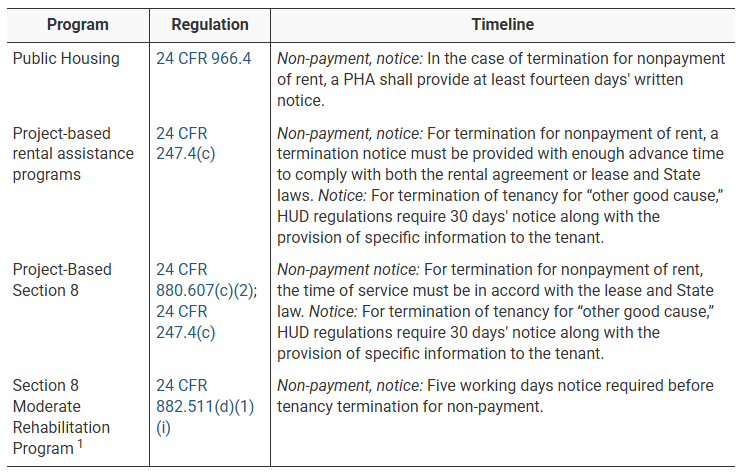
In the Notice, HUD focuses on other pandemic-related developments, but does not discuss the CARES Act or the legal obligation to follow CARES Act requirements for covered HUD properties. It also made the Rule effective before the comment period ends. The Notice provides HUD's rationale for this.
HUD Summary | HUD removed regulations to conform to the CARES Act, but does not discuss that the 30-day requirements relating to eviction and nonpayment of rent still exist in federal statute.
Step Four | Owner Must Assess the Legal Risk
At some point, Congress will likely repeal CARES Act 30-day notice requirements for non-payment-related evictions. At least one such proposal is in process. However, until then, the CARES Act eviction provisions have not ended for covered properties, despite the impression that owners/agents may have after recent regulatory actions by the primary federal housing agencies.
Besides a general need to follow the law, what factors and penalties may owners/agents and their counsel assess in making decisions around eviction policy? Realistically, the CARES Act does not impose specific penalties for breaking the 30-day notice law, so the primary consequences would appear to spring from the legal costs that may accompany the eviction process, and this will be a factor in an owner/agent's risk analysis. Paradoxically, HUD and RD's actions have triggered action and discussion among lawyers who advocate for tenant rights, and efforts to pursue vigorous legal action in cases of eviction law violations may result, even for low-income tenants with more limited legal resources than owners/agents generally have. Risks may include:
- Tenant legal defenses. Tenants may successfully raise violations of the CARES Act as a defense in eviction proceedings.
- Eviction dismissal or delay. Courts may dismiss or delay eviction actions if the required 30-day notice was not provided, requiring the owner to restart the eviction process, adding legal costs, and increasing nonpayment loss.
- Potential program or contractual issues. Even without regulations in effect, for properties participating in federal housing programs or financed with federally backed mortgages, failure to comply with applicable federal law may raise concerns during oversight, monitoring, or loan servicing reviews, depending on the requirements of the governing program documents.
HUD and Rural Development may have removed their regulations, but the CARES Act itself remains on the books. For owners and agents, the question is no longer what the regulations say—but what risk they are willing to accept if a court applies the statute as written.
Advertisement
Be in on the discussion of all the nuances for eviction and other shifting issues.
Click the image below for more information and to register.

There is a very good chance that the topic of this post is covered in an online on-demand course at Costello University.
Stay connected with news and updates!
Join our mailing list to receive the latest news and updates from our team.
Don't worry, your information will not be shared.
We hate SPAM. We will never sell your information, for any reason.